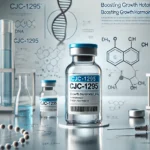

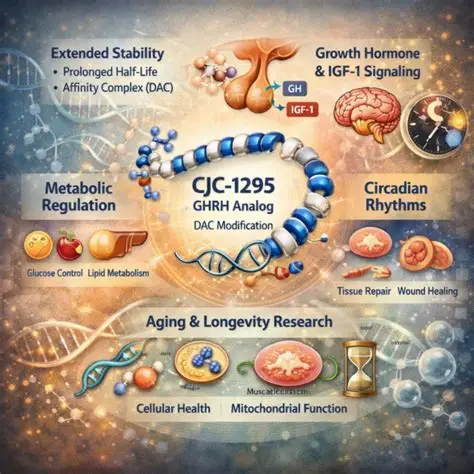
The CJC-1295 research results for metabolic efficiency in 2026 are uncovering new data on lipid oxidation and energy homeostasis. By extending the growth hormone pulse, CJC-1295 (with DAC) provides a steady research environment for studying long-term metabolic shifts. This is a key area for those also following our peptide cycling protocols.
Metabolic Research Highlights
Studies focus on the compound’s ability to enhance nitrogen retention and lean tissue preservation. For more on tissue repair, see our HGH regeneration guide.
CJC-1295: Investigative Overview of Metabolic Efficiency and Growth Hormone Modulation
CJC-1295 is a synthetic tetrasubstituted 29-amino acid peptide, specifically a Growth Hormone-Releasing Hormone (GHRH) analog. In clinical research settings, it is primarily studied for its ability to extend the half-life of GHRH, thereby providing a sustained release of endogenous growth hormone (GH) and Insulin-like Growth Factor 1 (IGF-1).
Unlike the naturally occurring GHRH, which has a half-life of mere minutes, CJC-1295 utilizes Drug Affinity Complex (DAC) technology or specific modifications (as seen in CJC-1295 No DAC) to maintain biological activity for significantly longer durations.
The Mechanism: The GHRH-Pituitary Axis
CJC-1295 functions by mimicking the action of endogenous GHRH. It binds to the GHRH receptors in the anterior pituitary gland, stimulating the pulsatile secretion of Growth Hormone.
$$\text{CJC-1295} \rightarrow \text{GHRH Receptor Binding} \rightarrow \uparrow \text{Endogenous GH Pulse} \rightarrow \uparrow \text{Hepatic IGF-1 Production}$$
This process is highly regulated by the body’s natural feedback loops, which typically minimizes the risk of the “shut down” effect often seen with exogenous hormone replacement therapies.
Research Findings: Impact on Metabolic Efficiency
Research into CJC-1295 has highlighted several key areas where the peptide influences metabolic rate and body composition:
1. Enhanced Lipid Metabolism (Fat Oxidation)
One of the primary research outcomes is the peptide’s role in lipolysis. By increasing GH levels, CJC-1295 promotes the breakdown of adipose tissue. Growth hormone stimulates hormone-sensitive lipase (HSL), which facilitates the mobilization of stored fatty acids to be used as energy.
2. Protein Synthesis and Lean Tissue Preservation
Increased IGF-1 levels, secondary to CJC-1295 administration, are strongly associated with nitrogen retention. For researchers, this indicates a potent environment for muscle tissue repair and the preservation of lean mass, even during caloric deficits—a cornerstone of metabolic efficiency.
3. Improved Cellular Repair and Recovery
Research subjects often exhibit accelerated wound healing and improved skin elasticity. This is attributed to the systemic increase in GH, which plays a vital role in cellular regeneration and collagen synthesis.
4. Deep Sleep Cycles (REM and Slow-Wave Sleep)
Metabolic efficiency is deeply tied to circadian rhythms. Research indicates that GHRH analogs can improve the quality of Slow-Wave Sleep (SWS). Since the majority of natural GH secretion occurs during deep sleep, this creates a positive feedback loop for metabolic health.
Technical Specifications for Researchers
| Feature | Data |
| Molecular Formula | $C_{152}H_{252}N_{44}O_{42}$ |
| Molecular Weight | $3367.9 \text{ g/mol}$ |
| Sequence | Tyr-d-Ala-Asp-Ala-Ile-Phe-Thr-Gln-Ser-Tyr-Arg-Lys-Val-Leu-Ala-Gln-Leu-Ser-Ala-Arg-Lys-Leu-Leu-Gln-Asp-Ile-Leu-Ser-Arg-NH2 |
| Purity | > 99% |
| Storage | Lyophilized powder: 2-8°C; Reconstituted: < 4°C |
Summary of Research Outcomes
- Sustained GH Elevation: CJC-1295 provides a consistent baseline of GH without the “peak and crash” of shorter peptides.
- Body Composition: Significant data points toward a reduction in visceral fat and an increase in lean muscle markers.
- Metabolic Rate: Enhances the basal metabolic rate (BMR) by shifting the body’s primary fuel source toward stored lipids.
Research Note: CJC-1295 is strictly for in-vitro and laboratory research applications. It is not approved for human or veterinary consumption. Researchers should adhere to all laboratory safety protocols when handling this compound.