

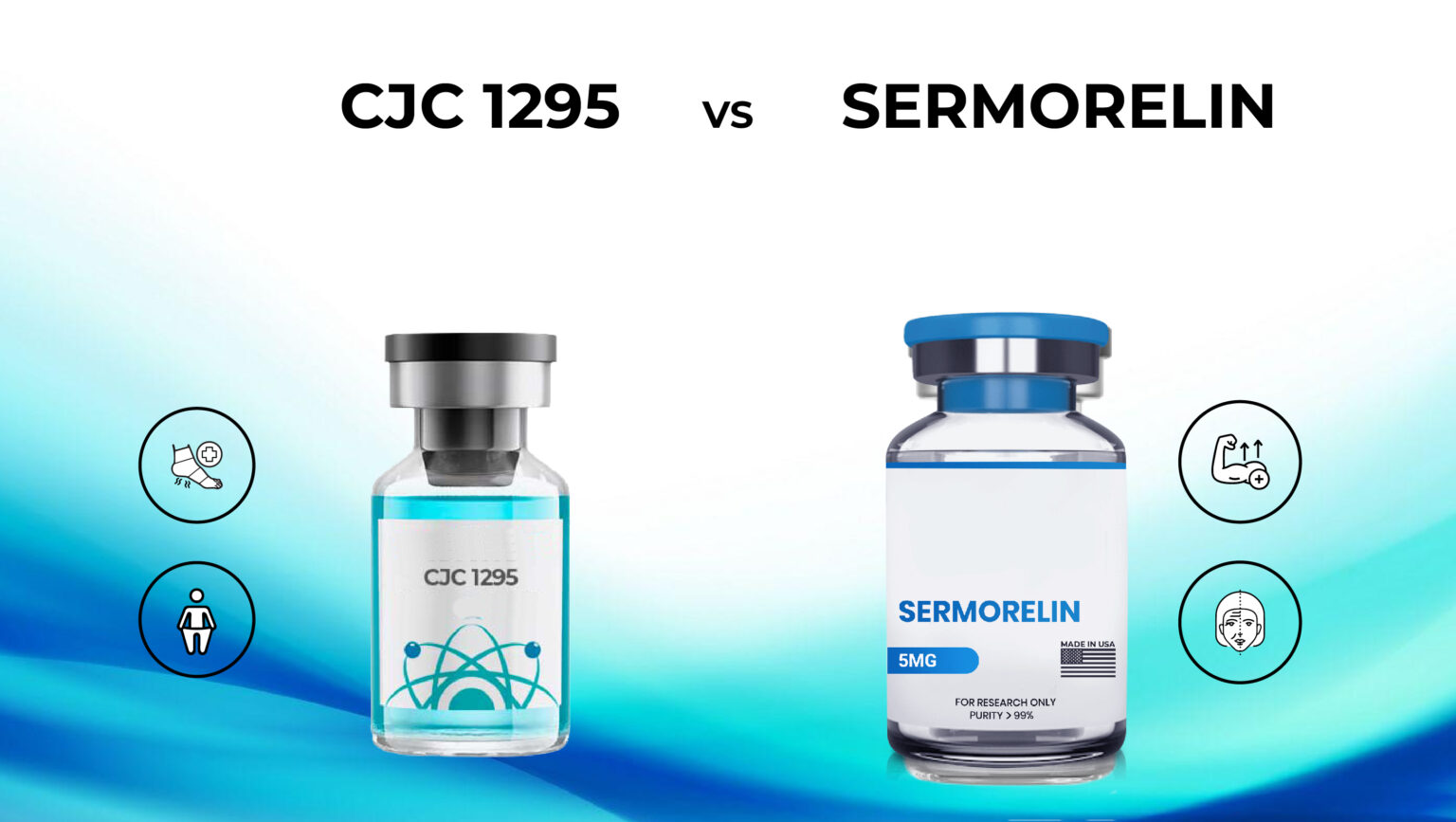
Comparing Sermorelin vs CJC-1294 research data is essential for understanding growth hormone secretagogue (GHS) kinetics in 2026. While both stimulate the pituitary, CJC-1295 (especially with DAC) offers a longer half-life compared to the rapid action of Sermorelin. For researchers focused on lean mass, our muscle wasting research guide provides additional context.
Key Differences in GHS Research
- Sermorelin: Short half-life, mimics natural GH pulses.
- CJC-1295: Extended duration, steady-state GH elevation.
Sermorelin vs CJC‑1295: Research Data on Growth Hormone Modulation
1. Introduction
Growth hormone (GH) plays a pivotal role in metabolism, tissue repair, and cellular health. Two synthetic peptides — Sermorelin and CJC‑1295 — are widely studied for their ability to stimulate GH release via the growth hormone–releasing hormone (GHRH) receptor. While both act as GHRH analogs, they differ significantly in structure, half‑life, and research applications.
This article explores the research data comparing Sermorelin and CJC‑1295, highlighting their mechanisms, outcomes, and implications for hormone balance studies.
2. Shared Mechanism
- GHRH Agonists: Both bind to GHRH receptors on pituitary somatotrophs, activating cAMP/PKA signaling and stimulating GH release.
- Pulsatile Secretion: Unlike exogenous GH injections, they promote natural GH pulses, aligning with circadian rhythms.
- Synergy with GHRPs: When combined with growth hormone secretagogues (like Ipamorelin), GH peaks are amplified, offering valuable research insights.
3. Sermorelin Research Data
- Structure: A 29‑amino‑acid fragment of GHRH (1‑29).
- Half‑Life: ~10–15 minutes; short‑acting.
- GH Profile: Produces a single, discrete GH pulse lasting 1–2 hours.
- Applications:
- Diagnostic tool for GH deficiency.
- Studies requiring short, physiological GH pulses.
- FDA Status: Approved as Geref for diagnostic use in GH deficiency testing.
Research Findings:
- Effective in stimulating GH release in children with GH deficiency.
- Mimics natural hypothalamic signaling closely, making it ideal for physiological studies.
- Limited by short half‑life and dependence on somatostatin tone.
4. CJC‑1295 Research Data
- Structure: 30 amino acids with stabilizing substitutions; available in DAC (Drug Affinity Complex) and No DAC versions.
- Half‑Life:
- DAC version: up to 6–8 days.
- No DAC version: ~30 minutes but more stable than Sermorelin.
- GH Profile: Sustained GH elevation, multiple pulses over days.
- Applications:
- Long‑term GH axis modulation.
- Aging and metabolic research.
- FDA Status: Research‑only; not approved for therapy.
Research Findings:
- DAC modification allows weekly or biweekly dosing in research protocols.
- Produces significant, prolonged IGF‑1 elevation.
- Less sensitive to somatostatin inhibition, maintaining GH release more consistently.
5. Comparative Analysis
| Feature | Sermorelin | CJC‑1295 (DAC & No DAC) |
|---|---|---|
| Structure | GHRH 1‑29 fragment | Stabilized 30‑amino‑acid analog |
| Half‑Life | ~10–15 minutes | DAC: 6–8 days; No DAC: ~30 minutes |
| GH Profile | Single pulse, short duration | Sustained elevation, multiple pulses |
| IGF‑1 Effect | Modest, transient | Significant, prolonged |
| Somatostatin Sensitivity | Highly dependent | Less sensitive |
| Research Use | Diagnostic, short‑term studies | Long‑term endocrine modulation |
| FDA Status | Approved diagnostic | Research‑only |
6. Risks & Limitations
- Sermorelin: Requires frequent administration; results vary with somatostatin levels.
- CJC‑1295: Extended GH elevation may risk receptor desensitization or altered feedback loops.
- Both: Not approved for therapeutic use outside controlled research.
7. Educational Insights
- Sermorelin is best for mimicking natural GH pulsatility and short‑term diagnostic research.
- CJC‑1295 is suited for sustained GH/IGF‑1 elevation in long‑term metabolic or aging studies.
- Choosing between them depends on research objectives: physiological rhythm vs prolonged stimulation.
8. Conclusion
Sermorelin and CJC‑1295 represent two distinct approaches to studying GH modulation. Sermorelin offers short‑acting, physiological pulses ideal for diagnostic and acute studies, while CJC‑1295 provides long‑acting stimulation suited for chronic research models. Together, they illustrate how peptide engineering can tailor endocrine responses for specific scientific goals.





One thought on “Sermorelin vs CJC-1295 Research Data”